MIAMI
UNDERGROUND
Cuban Rebels in Action 1958
[REFERENCE:
Man's Magazine, April 1959, Vol. 7, No. 4, pages 24-25,
86-90 ]
Page 4
MAN'S was bird-dogging
the "Miami
Underground" story (page 24) long before Castro's
partisans began
openly to turn Miami and environs into a revolutionist's
supermarket. In fact, as MAN'S goes to press,
exploits reading
like Dumas, Conrad and London pop up daily in the
nation's newspaper:
"FORT LAUDERDALE,
FLA.
- An arms laden plane and 22 persons were seized here
today amid
gunfire when police interrupted loading operations at an
abandoned
airfield."
"MIAMI, FLA. -
Three
Cubans, two of whom wheeled their fleeing munitions
packed car into a
crowded dog track, were captured after a shooting chase
of 12 blocks."
"OCALA, FLA. -
An alert
road patrolman intercepted an auto convoy of arms for
Cuban rebels
early today and eight persons, including a Miami soldier
of fortune,
were arrested after a two-county chase."
"Underground" byliner
Jack Kofoed
knows Florida and Cuba as well as he knows his wife
after 35 years of
marriage. A Miami Herald columnist, Jack has seen
the rebels in
action in Cuba and Florida!
Page 24
MIAMI UNDERGROUND
[To see a
full size photo, right click and VIEW IMAGE]
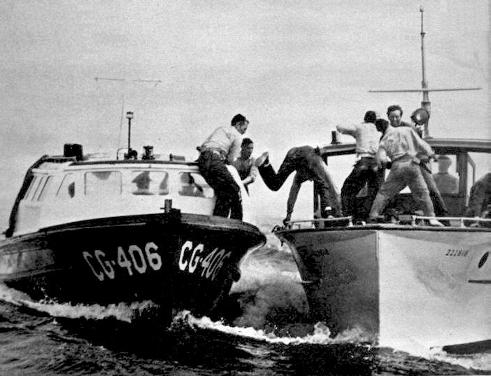
[caption] EDITOR'S NOTE: As MAN'S went to press, rebel
troops conquered
Cuba. This story reveals, in part, how Fidel
Castro's small
insurgent group overthrew Strong Man Batista's regime.
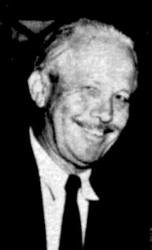
by Jack Kofoed
FICO SAT in the sunshine of Miami's Bayfront Park, smoking a
cigarette. He wore rope-soled canvas shoes called
alpargatas and
a soiled white guayabera shirt hung outside his pants.
Fico is a friend of mine. I met him years ago at the
Havana jai
alai fronton, which stands in a maze of narrow slum streets,
crowded,
smelly and brawling with noise. He seemed acquainted
with
everybody, but what he did for a living I never knew.
After Batista had unseated Dr. Carlos Prio Socarras as
president of
Cuba, Fico left Havana hurriedly and settled in Miami.
He speaks
English well, and since there are 45,000 of his countrymen,
most of
them anti-Batista, in Dade County there is no opportunity to
become
lonesome. Saloons along Miami Avenue are not as cozy
as the
bodegas he frequented at home, and he missed his favorite
goat stew,
chilindron; but after all, you can't have everything.
When Fico arrived, there was only a splinter anti-Batista
underground
in Miami. It began to grow, stimulated by rebel leader
Fidel
Castro's first attacks against the government. Once
Fidel led 80
followers from a diesel-powered yacht to the sandy beach at
Nicaro. There they were met by gun-blasting soldiers,
and only 20
rebels lived through the barrage. His 26th of July
assault on the
Moncada barracks proved equally disastrous. Both times
Castro was
captured and pardoned by Batista. But he became a
symbol, not
only to countrymen in Cuba, but to those Cubanos who had
gone, either
voluntarily or through duress, to Miami.
page 25
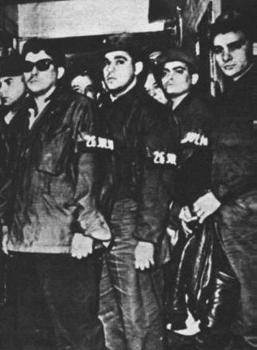 [caption] Gunrunners
caught in boat headed for Cuba include ex-Brooklynite
Antonio Lopez (rt.).
Machine-guns riddle an Army
car in
Havana...A farmer in Pinar
del Rio
shoots a cop...An
incendiary bomb
fires an Oriente sugar
field...And
behind it all are the
American-based
gunrunners who have turned
the
world's winter playground
into
a menacing cloak-and-dagger
city.
[caption] Gunrunners
caught in boat headed for Cuba include ex-Brooklynite
Antonio Lopez (rt.).
Machine-guns riddle an Army
car in
Havana...A farmer in Pinar
del Rio
shoots a cop...An
incendiary bomb
fires an Oriente sugar
field...And
behind it all are the
American-based
gunrunners who have turned
the
world's winter playground
into
a menacing cloak-and-dagger
city.
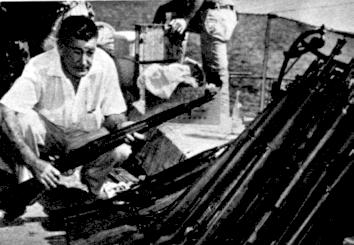 [caption] Arms recovered
from the cruiser Harpoon
[caption] Arms recovered
from the cruiser Harpoon
are sorted after cutter intercepted ship at sea.
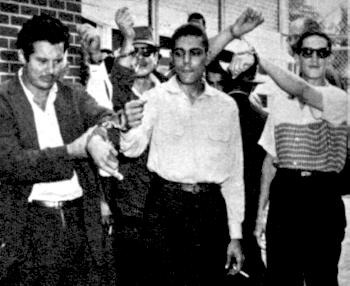
[caption] Handcuffed in pairs, members of the Cuban
underground are taken to Miami on charges of smuggling.
In the years that have passed, the Miami underground
developed into an
incredible network of intrigue, turning the world's largest
winter
playground in the gaudiest cloak-and-dagger city in the
hemisphere. Members work in every possible way for
Castro,
raising money and shipping arms, ammunition, food and
medicine, as well
as recruits, to him.
Expatriated Cubans, particularly those who have not become
citizens,
take great risks. The latter can have their visas
revoked, and be
sent back to face Batista's wrath at home. They know
that, but
regard Castro's rebels as freedom fighters, likening them to
the
Hungarians who died under Russian machine-gun fire in the
gutters of
Budapest.
"A big day for us, this," Fico said, jabbing at me with his
cigarette. Having covered stories now on the front
page of my
paper, the Miami Herald, I knew exactly what he meant . . .
A Cubana Airlines' DC3 took off from Guantanamo carrying
eight
passengers and a crew of three. The first leg of the
journey to
Moa Bay is only a 15-minute run. When the plane was
airborne,
three men, pistols in hand, rose from their seats. One
stood
guard over the other passengers, the others went to the
cockpit, and
gave orders to the pilot. Looking into the threatening
muzzles,
there was nothing the pilot could do but obey.
He was ordered to fly over the Sierra Maestra range and set
his wheels
down on an airstrip controlled by the rebels. Castro,
having
strengthened his ground forces, wanted to add to his
incipient air
force. The DC3 could be equipped with makeshift bomb
racks, and
the improbable dream of bombing Havana might be made a
reality.
Almost simultaneously, guerrillas attacked an army outpost,
killing
half a dozen soldiers in a sharp,
continued Page 86
brief fight, then slipping back into the hills.
The success of the kidnaping set off a spate of
others. A few
days later another Cubana Viscount turbo-jet warmed up on
its strip at
Miami International Airport. Seven Americans boarded
the plane
for a flight to Varadero Beach. Mingling with them
were four
Cuban rebels, who apparently had been based in Miami for
some time.
Their pattern was the same as in the previous coup.
When safety
belts had been unloosened, cigarettes lighted, and a
stewardess began
serving daiquiris, the four rebels brandished their
automatics and
ordered the pilot to fly to the Castro-occupied province of
Oriente. Though there are no witnesses to testify, the
pilot must
have protested. Landing on a rough, badly-lit airstrip
in the
mountains would be hazardous.
Shrugs, palms of hands upward. Quien sabe? Who
knows?
We take chances every day. What does another amount
to? So,
the pilot lined up his plane for the approach, misjudged the
strip, and
crashed into Nipe Bay. Result: 17 lives lost.
Miami's rebels are hard men, not easily discouraged.
Many must
die if their objective is to be achieved. What
difference if
death comes in a plane or on the battlefield? It's too
bad if
innocent people go, too, but in war everyone is expendable.
Havana lies 250 miles from Miami, across the blue-green
waters of the
Caribbean. It was a sophisticated, Continental city,
where
gambling and sex were flaunted. Today, since Castro's
shadow fell
across it, it is neither gay nor carefree. And one
reason why the
shadow persists lies in the Miami underground.
A little grocery store on the West Side, a Spanish
restaurant on Miami
Avenue, a motel on Miami Beach may be important
revolutionary action
centers. The bus boy who removes dishes from your
table in a
hotel dining room, the taxi-driver who takes you to the
airport, the
woman who waits on you in a shop - may be leaders in the
movement.
Machine-gun bullets rip through a military intelligence car
in Havana .
. . a farmer in Pinar del Rio fires a .45 automatic pistol
at a
threatening police lieutenant . . . an incendiary bomb burst
sends
flame roaring through fields of sugar cane in Oriente.
Guns, ammunition and explosives are the muscle and sinew of
revolution. Even the toughest guerrillas can't wage
war with
knives and machetes. In the business of getting
weapons, the
rebels look at Miami as a housewife regards a
supermarket. It is
the funnel through which supplies, purchased in different
parts of the
United States, are poured. Private planes are air
lifted from
isolated airports, carrying every pound allowable.
Speed boats
take off all the way from Fort Lauderdale to tiny islets
near Key West,
not only with weapons, but recruits for Castro's small
army.
Individuals fly on regularly scheduled airlines, weapons
strapped to
their bodies . . .
"It's kind of funny," said Fico. "I mean, how much we
do, and how
little people around town know about it. ‘Batista!
Castro!' they
say. ‘We've got enough troubles of our own without
worrying about
those Cubans!' So, it's only when they read about
police picking
up machine guns in an apartment, or the Border Patrol
capturing one of
our boats, that they even give us a thought. But, we
have mucho
trouble just the same, with the FBI, Border Patrol, local
police, and
others on our tails.
"There are plenty of Batista secret police here, too.
Sometimes
even citizens who don't know anything about us get us in
jams.
Like a taxi-driver, suspicious because his fare's bags were
so
heavy. He told a policeman, and we lost 40 automatic
pistols. Still, we get through about 90 per cent of
what we send."
That is doubtful. The Border Patrol estimates 50 per
cent, so the
real truth probably lies between those figures.
Whatever it is,
the job has been amazing. There have been few
occasions when
Fidel Castro's men ran short of ammunition.
Occasionally stories creep into the papers . . . stories
flame-lit with
drama. They represent only a minute bit of what goes
on day after
day in the luxury capital of the world. One concerned
the 60 foot
cabin cruiser Harpoon, hired for a gunrunning
expedition. It was
an old boat. As a cover, while loading, the rebels
painted its
hull. Some observant soul noticed that, while standing
high in
the water when loading began, the Harpoon settled deeper and
deeper as
its cargo of guns and ammunition was loaded. So - too
late to
forestall the cruiser's departure - a tip was passed along
to the
Border Patrol.
The 32 men aboard wore arm bands marked "Comando Calixto" or
"OA." The first was for a revolutionary who died in an
attack on
the Presidential Palace in Havana; the second for
"Organizacion
Autentico," a political party headed by former President
Carlos Prio
Socarras. The cargo was made up of mortars, antitank
guns,
ammunition and supplies, all vital needs for Castro's
guerrillas.
The filibusters (gunrunners) were aware of the danger they
faced.
If the Harpoon outrode American hunters, more ominous danger
lay ahead
when they made a landing on the Cuban coast. There,
the
underground would face no fines, not short prison
terms. Security
police shoot first, ask questions, if any, afterward.
There were
times when they hanged filibusters to the nearest trees
without even a
drumhead court-martial.
Realizing this, the men aboard the Harpoon were tight as
fiddle strings as the cruiser cut a path through the quiet
waters.
Suddenly a searchlight silhouetted them against the
blackness. A
voice shouted: "Keep on course . . . keep on course!"
The cutter
Douglas C. Shute slid alongside, but the rebel helmsman paid
no
attention to the order. He spun his wheel, slamming
the Harpoon
into the bank.
Below deck men frenziedly smashed port holes and tossed
contraband into
the water. Others poured up on the deck, screaming in
frustrated
anger. One man pointed a Tommy-gun at Inspector
Raymond D. Bond,
pulled the trigger . . . but the weapon jammed.
Another attempted
to blow up the gas tank with the detonator of a hand
grenade. It
exploded in his hand, ripping off a couple of fingers.
For a moment it was touch and go. There were only
seven agents
against 32 filibusters, but cooler heads among the rebels
prevented
carnage. Some talked about making a break when they
landed at
Fort Lauderdale, but a large number of police were on hand
when they
landed, so the attempt was never made. This was not
the first
catch of its kind made by the Border Patrol. Ten
months before
they descended on Big Pine key, and took another cruiser,
Philomar III,
with 30 men, listed as reinforcements for Castro, and a
considerable
amount of arms aboard.
Page 87
When the excitement was over, the prisoners did not resent
their
arrest, and considered their capture an incident of
war. They
took the position that they were patriots, and doing no more
than any
patriot should. They were heartbroken at having failed
in the
adventure, but determined to try again.
Most boats used for filibustering are rented, often from
owners who
know nothing of the purpose for which they will be
used. Some are
purchased outright, like the Corinthia, which was used in a
ghastly
fiasco, an attack on the Cuban coast in which most of the
men she
carried were shot by troops lying in ambush.
Failures, trouble from without, sometimes treason from
within their
circle, even deaths, have not deterred supporters of the
revolution. All Cubans in Miami are not sworn enemies
of the
Batista government. Some think the stocky, one-time
sergeant has
done much for the country. The majority, though,
contribute money
and support to Castro.
Originally Castro found his weapons in hit-and-miss
fashion.
Maids in the homes of Army officers or police officials were
bribed to
tip off rebels to the time when families would be
absent. Then
they'd break in and steal whatever side arms they could
find.
This furnished only a trickle of what was needed. When
the
situation became desperate, hit-and-run attacks were staged
on armories
or barracks, where rifles and Tommy-guns were in large
supply.
These raids alerted the government so success became more
and more
difficult to achieve.
As political arrests increased, thousands of Cubans fled to
Miami. The majority are by no means rich. They
work at a
variety of jobs at average, or less than average,
salaries. Some
own restaurants or stores. There are a few wealthy men
like
former President Dr. Carlos Prio Socarras, who was
overthrown by
Batista in 1952.
Handsome, mustachioed Prio, who lives in the penthouse of
Miami Beach's
Vendome Hotel, is credited with being the bankroll of the
underground. The ex-president denies this, but when
brought to
rial for violating the National Security Act several years
ago he
pleaded nolo contendere, and was fined $9,000. In
February, 1958,
Prio was indicted by a Federal Grand Jury for the same
offense, which
allegedly, in his case, meant smuggling arms and troops.
"The good doctor is important to us," Fico said, " but we do
not want
him for president again when we win. Many of us do not
want
Castro either . . . Who do we want?" He shrugged his
shoulders. "Who can tell? We are funny
people. You
see what goes on around here. You know."
Though all out for the revolution, Miami's Cuban are split
into several
organizations, divided in aims and ideas as to how to help
the
revolution: One, the "26 of July" movement, is named
after the
day the guerrilla leader made his dramatic attack on the
Moncada
barracks. Another is the "Directorio
Estudiantil,"composed of
students and intellectuals; the "Autentico Party,"is Dr.
Prio's pet.
Leadership is not always decided by wealth, social standing
or previous
political prominence. Among section groups, which do
the
gunrunning, one is led by a bus boy.
There is no strength in division, and Castro's supporters
are beginning
to realize this. Many believe the failure of a general
strike
followed by all-out war, announced a year ago, was partly
due to
contradictory intelligence Castro received from Miami
followers.
Page 88
Being emotional, the Cubans sometimes act without
thinking. They
staged several street demonstrations in Miami against police
orders. Some hotheads beat up a legislator, Rodolfo
Masferrer
Rojas, and Justo Luis del Pozo, son of Havana's mayor, while
they were
visiting the city.
"That was foolish," said Fico. "It makes us look like
hoodlums,
and we are not hoodlums. It attracts attention to us,
and we do
not need attention. Many of us are here on temporary
visas - we
can be sent back to Cuba; and you know what happens to us
then."
He made a slitting motion across his throat.
Most Miami-based Cubans are beginning to realize that.
Of late
there have been no public demonstrations, though many of the
more
fanatical rebel supporters openly claim the United States
gives aid to
the Batista government.
These, then, are the people who have turned Miami into the
hemisphere's
most conspiratorial city. They gamble a million
dollars a year on
getting supplies to Castro, and "gamble" is the proper word,
since they
have no idea of how much will actually get through.
Buyers negotiate with arms dealers in New York, Washington,
Hartford
and Los Angeles . . . Mls, carbines, Thompson sub-machine
guns,
automatic pistols, shotguns, .75 mm. anti-tank guns and
grenades are
wanted most. Purchasing agents are busy, on a smaller
scale, in
Mexico, the Dominican Republic, Venezuela, Costa Rica and
even Europe.
World War II Army machine guns are purchased ostensibly as
souvenirs. These were deactivated under government
supervision by
welding the barrel of the gun to the receiver, or operating
mechanism,
and plugging the barrel. This is an easy problem to
lick.
The government weld is broken, the barrel replaced, and the
gun turned
into a deadly killer.
The Cubans also alter electrically operated machine guns,
designed for
use in aircraft. Tripods, triggers and rifle butts are
welded on,
which, users say makes the weapon more defective than the
BAR.
There has been a marked increase in business for Miami
firearms shops,
and in most instances sales are legal. It is lawful
for a
traveler to carry three hand guns, or rifles, out of the
country; one
person making several trips, with ammunition strapped under
his
clothing, can supply a 10-man fighting unit for a week.
All weapons are not earmarked for Castro's mountain
fighters, or even
for Fifth Columns scattered throughout the Sugar
Republic. Plans
have been laid not only for the next battle, or the next
campaign, but
the future. Underground training schools are set up in
rural
provinces, where recruits are taught to assemble and use
smuggled arms.
"A isn't a factor," said Fico. "Middleaged farmers and
young boys
get the hang of it in a little while. Why, I even know
one old
woman who can put together three rifles while she boils a
pot of
rice. These people are not fussy about what they
get.
Anything which shoots when the trigger is pulled will do.
There is little difficulty buying weapons, much in getting
them
through. The rebels have adopted some of the
techniques of
Prohibition-era bootleggers. They establish "drops"
where guns
can be deposited, to be picked up later.
Shipments move from originating points by trucks,
automobiles, house
trailers and rental trailers. If from New York or
Hartford, they
are stored in warehouses in Savannah or adjacent
communities, until
broken into small lots to be transported, usually by private
car to
Miami.
Here they are kept in homes, motel rooms, garages or barns
while
details for getting them out of the country are
perfected.
Security is essential, and while security is excellent for
such loosely
knit organizations, the FBI, other government agencies or
local police
often find out what is happening.
For example, customs agents learned that 200 M-1 carbines
had been
bought in Alexandria, Virginia, moved out and stored in
Savannah.
In the dark of night three Cubans loaded those guns in two
cars and a
trailer and headed for Miami. They took turns driving,
and they
drove fast. It wasn't until they had reached Pompano
Beach, on
the Florida Turnpike, that the agents, by that time
reinforced with
Florida Highway Patrolmen, caught up with the caravan,
arrested the
men, and confiscated the carbines.
There is danger from money-hungry rebels and unscrupulous
dealers and
gangster, who want to get their hands on rebel loot, as well
as from U.
S. law enforcement authorities and the Cuban secret
police. There
have been members of the inner circle, entrusted with large
sums with
which to buy guns, who made deals with sellers to raise
their prices
and then split the difference with the traitors.
Even the underworld has, on occasion, edged into the
act. Two
rebel agents named de la Torre and Madariaga left Miami on a
buying
trip carrying $248,000. Because of the nature of these
transactions, cash on the barrel-head is the only accepted
method of
doing business. A hoodlum named Gene Norris convinced
the Cubans
he could make a better deal for them than anyone else.
After
roundabout journeys through several states, de la Torre and
Madariaga
were held up at gunpoint in a Fort Worth, Texas, motel and
robbed of
every dollar they had.
Later, when Norris attempted to pick up the money from a
cache where he had hidden it, he was shot to death by Texas
Rangers.
The cloak-and-dagger Cubans have come to accept such hazards
and
unhappy results as inevitable parts of their program.
There must
be waste and losses in war, and the only yardstick of the
underground's
success is the percentage of supplies which get through.
There are many secret meeting places which, of necessity,
must be
changed from time to time. One, used for a long time,
was an
abandoned private airport west of Fort Lauderdale.
Castro
sympathizers gathered there, sometimes in large numbers,
without
arousing suspicion. They flew model airplanes as a
cover, and the
mild funmaking brought no police to investigate.
Actually, a
rebel plane landed and took off from the strip at regular
intervals,
bringing instructions from the Man of Sierra Maestra, and
taking back
reports and money.
In October, three F51 fighters were destroyed by gasoline
bombs at
Broward International Airport. The owner said they
were to have
been converted into executive type aircraft. That
didn't sound
reasonable. Single seaters such as F51s equipped with
bomb racks,
could be made over only at excessive cost. Edward
Bethune, a
young soldier of fortune who left the rebel forces because
of illness,
said Castro planned to drop bombs on Havana; and authorities
suspected
the F51s might have been a part of this plan, just as the
captured
Cubana passenger plane undoubtedly was, too.
Personable, outspoken Jose Aleman owns the Trade Winds
apartments on
Miami Beach. He also owned- before selling it to the
city of
Miami-the Miami Stadium and an enormous amount of other
property left
him by his father, the late Cuban Senator Aleman.
Young Jose is
one of five men heading the "Directorio Estudiantil"
(Students
Council). He has helped many refugees make a new start
in Miami
but strenuously denies having anything to do with
gunrunning.
Exiles stay at the Trade Winds for undetermined
periods. One
afternoon last June, Dade County deputy sheriffs slammed
patrol cars to
a noisy stop in front of the apartment house. They
burst into
most of the units, when denied keys, and found 4,300 rounds
of
ammunition, 900 sticks of dynamite, two Tommy-guns and
navigational
charts covering waters between the United States and
Cuba. Three
young Cubans, on guard duty, were arrested. Jose
denied knowing
anything of the cache.
To show how widespread are the meeting places and "drops,"
500 rifles
were seized at a house on NE 110th St., a $25,000 cache
packed in oil
drums on a downtown pier, 600 sticks of dynamite on SW 18th
St., 34
machine guns and 83,000 rounds of ammunition on 27th Avenue
and
phosphorous bombs in an apartment on SW 5th St.
There is a feeling of sympathy here for men who risk so much
for an
ideal. Unless some hotheaded rebel, frantic at having
failed in
his mission, violently resists arrest, officers handle their
prisoners
gently. When gun runners are brought to trial, and
convicted,
federal judges temper justice with mercy. The men of
the Harpoon
were given only 60 days . . . and credited with time spent
awaiting
trial . . . plus a $200 fine each.
The case of slender young Hector Duarte Hernandez points up
this
attitude. Duarte, one of the few who lived through the
futile
attack on the Presidential Palace in Havana, escaped to
Miami.
Cuban police were anxious to get their hands on him, and
demanded
extradition.
The young man was brought before Federal Judge George
Whitehurst.
His attorney pointed out that sending Duarte back would be
equivalent
to passing a sentence of death. Judge Whitehurst
denied the plea
for extradition and, instead, levied a $300 fine for illegal
entry.
Perhaps this tolerance stems not only from sympathy for
people fighting
for what they conceive to be their rights, but to the fact
that
Florida's Gold Coast has a tradition for gunrunning which
goes back
many years. When Cubans were fighting for
independence, and the
Spanish Governor-General, Weyler, was earning the title of
"Butcher"
because of his atrocities, American feeling ran high.
Then, as
now, the government did what it could to prevent the
smuggling of
weapons.
Napoleon Broward, who later became governor of Florida,
owned a speedy
tug called Three Friends. Broward was sentimental and
practical. He wanted to help the patriots, but was not
averse to
turning a tidy profit while doing it.
He'd take the Three Friends up New River to Fort Lauderdale
and anchor
by the railroad bridge. A train would puff to a stop
on the
trestle, cases of arms and ammunition were lowered to the
tug, and then
he'd head south.
The Florida keys consist of innumerable small wooded
islands, sandbars
and reefs, which in any age make a haven for
filibusters. Revenue
cutters and Spanish ships of war chased Broward countless
times, but he
knew the keys as he knew his own engine room, and always
eluded
them. The governor-to-be was hauled into Federal court
on many
occasions, but no prosecutor was able to make a case against
him.
Page 90
The Three Friends rotted and sank years ago in the St.
John's River
near Jacksonville, but Napoleon Broward, long in his grave,
is still an
inspiration to men who run guns - Cubans and Americans.
For not all those who are a part of, or become involved in,
filibustering activities of the rebels are Cubans.
Having spent
time in Cuba, and written much about it, men from all parts
of the
United States and Canada have sent his writer letters asking
how they
could join Castro's forces. Most were from
disillusioned young
veterans who had not "found" themselves after getting out of
service,
or from old timers with a row of hash marks on their sleeves
who craved
more action. Some wanted to know how much Castro would
pay for
experienced machine gunners and riflemen. Many were
idealists
like sons of American Navy personnel at Guantanamo Bay, who
joined up,
but the chances of even such dedicated souls getting to the
Sierra
Maestra are small.
A Miami pipe fitter named Bill Leonard was arrested in
Oriente Province
when he strolled into a police station and asked for a pass
that would
get him within Castro's lines. He wanted to visit a
friend,
Charlie Ryan, who was fighting with the guerrillas.
Asking for
such a pass in a hotbed of rebel activity was akin to
requesting a
license to rob banks. When the astonished police
recovered their
poise, and searched the pipe fitter, he was lucky to get
away with his
life.
Leonard carried a small tear gas gun and a knife, protection
in that
troubled area, he explained, but the police didn't buy his
explanation
for quite awhile. After consultation with the American
consul,
they let Bill go, first warning him never to come back.
"Americans who want to join us," said Fico, "feel themselves
to be
modern Lafayettes, but they sometimes do things as foolish
as some of
our people. You never can figure out some men.
Like Cesar
Vega. Cesar was one of those captured on the
Philomar. Do
you know what he did before that ill-fated voyage?
Senor Vega
gathered a few friends and invaded a little dot of an island
called Cay
Sal, near the Cuban coast. It belongs to Great
Britain, and Cuba
does not give a peso for it but Cesar thought it a great
gesture to
capture the cay for our country.
"It took the British about 10 minutes to capture him and
throw him out,
but to some of our hotheads that was a fine and patriotic
thing to
do. That kind of thinking does us harm."
While a combination of Cubans, guns and raw emotions
supplies most of
the fuel for current action in Miami's underground
melodrama, there are
other factors poised to set off more revolutionary
clamoring.
Haiti has had bloody uprisings, but Haiti is poor and cannot
afford to
buy on the scale of Castro's backers. The Dominican
Republic is
restless, but those who seek Trujillo's overthrow are not
yet strong
enough to appear in the open. The ousted dictator of
Colombia,
Gustavo Rojas Pinilla, has returned there, and a nervous
government is
hopeful of blocking a new revolt. These and other
countries are
present or future possibilities as filibusters and potential
customers
of arms' salesmen. These fellows congregate in
Miami.
Whether or not there is anything imminent, they find it
easier to keep
their ears to the ground here than anywhere
else.
Ousted politicos of nationalities other than Cuban, like
Marco Perez
Jimenez kicked out of Venezuela, settle down for varying
periods.
Perez bought an estate on Miami Beach and hired off-duty
policemen on
three shifts to protect him and his property. So far
none of
these politicians in exile has been attacked successfully,
because they
are too well guarded.
In the meantime the guarded politicos hope for coups which
will take
them back to power while they mull away time in sun-drenched
Miami,
where during the winter season, horses race at Hialeah . . .
Joe E.
Lewis tells his funny blue stories at the Eden Roc . . .
long-legged
beauties relax in the sun at cabana clubs. And not one
in a
thousand tourists even dreams of the international melodrama
being
played under their nose.
Fico threw away his cigarette, stood up, and stretched
lazily.
"What goes on here," he said, "will go on until we get what
we want,
which is freedom for Cuba. But when that times comes,
and we can
cease our activities, Miami will still be the center of
foreign
intrigue. Other Latins have seen what we have done in
spite of
all handicaps. When Cuba finds peace, there will be
other rebels
from the Dominican Republic, Haiti and maybe a dozen other
countries
who will try to copy us. You can bet every peso you
have Miami
will be a revolutionary center for years to come. In
the
meantime, though, there is much for us to do . . . and no
matter how
your people try, no matter what the obstacles you put in our
way, we'll
get to Castro what Castro wants."
A plane flew overhead flying a banner advertising a night
club.
"I wish it was flying over the Presidential Palace, with a
bomb in its
belly," said Fico. "Maybe we'll see that pretty soon!"
End of Page
Copyright
1998-2014 Cuban Information Archives. All Rights
Reserved.


