WILL
REDS TAKE OVER?
(1954)
[REF:
Dare Magazine, Vol. 1 No. 11, March 1954, pp 5-11]
BLOODY CUBA
----------------------------------------------------------------------
[NOTE: The following,
partial news
article, was overlaid upon bloody corpses used as a header
for the main
article. Since it contained some pertinent
information, it is
being placed here as is]
Seek Outlawed Reds
as Bombs Shake Havana
Havana, Nov. 11 (UP) – Bomb explosions through
this tropical capital last night and early today less
than 24 hours after the Cuban government had
outlawed the Communist Party.
At lease three blasts were heard during the night,
and unexploded bomb was found suburban Vedado.
No casualty or serious damage were reported immediately.
One bomb, described by police as "moderate powerful,"
set off in a park a block from home of Interior Minister
[original article cut] Ra.. O. Hermida.
[original article cut]...exploded bomb, a [original
article cut]
----------------------------------------------------------------------
[Main article follows]
WILL REDS TAKE OVER?
By next week there could be a Soviet-controlled communist
government
within 90 miles of U.S. shores. That's the distance
from key West
to Cuba, currently the bloodiest and most unstable nation in
the West
Indies.
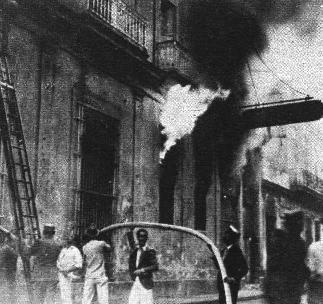
[To see a full size photo, right click and VIEW IMAGE]
Raid on a Communist Newspaper ..
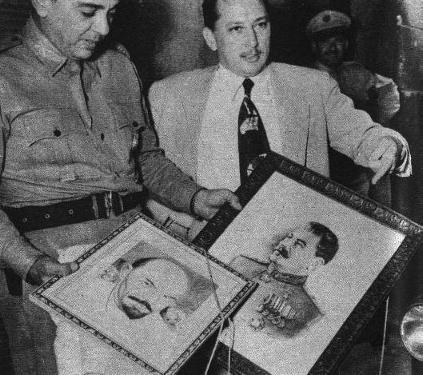
Yield Portraits of Communist
Leaders
Gen. Fulgencio Batista who took power nearly two years ago
in an army
coup still maintains his position precariously. He has
attempted
to solidify his power by swift and strong action against
communists and
other opposition elements, but the fact remains that the
Reds are the
most solidly organized and military effective threat to the
stability
of today's Cuban government.
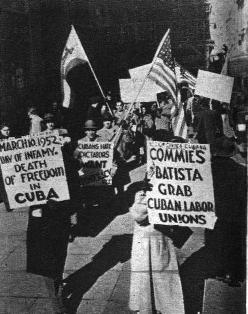
1953 New York Protests
against Batista
[To
see a full size photo, right click and VIEW IMAGE]
Since the ‘52 coup the Reds have quietly been gathering
strength and
sympathy from disgruntled labor groups, unhappy Liberals,
and even
rightist extremists who would do anything to see the Batista
government
displaced.
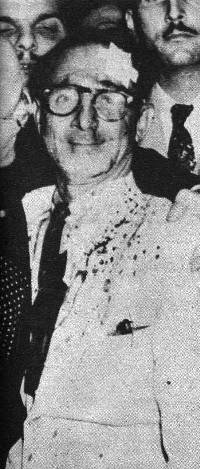
Eddie Chibas Injured
During Batista 1952 Coup
Key to the success or failure of the Communist attempt in
Cuba is the
sugar situation. Sugar provides 4/5 of Cuban exports,
3/4 of
products handled by Cuban railroads, 2/3 of government
revenues, 1/3 of
all the employment of the Cuban people. But for Cuba,
the sugar
situation is none too sweet. The slightest drop in
world market
prices causes havoc on the island, gives the Communists
their chance.
Constant agitation by students and Liberals for a democratic
constitution, the right to elect a president of their
choice, have been
the surface manifestations of underlying discontent.
Demonstrations are always suppressed, sometimes with bloody
results. But under the surface Communist cells are
active among
workers and peasants, furnish the real threat to Batista's
continuing
political existence.
Before Batista took complete power in his own hands,
Communists were
vociferous in Cuba. Dr. Juan Marinello, Communist
chief, ran for
the Presidency in the last election, while numerous
Communist delegates
were in the Cuban Congress.
What makes situation so difficult for U.S. State Department
is that
Cuban democracy's only hope lies with liberalization of
politics and
social reform, yet much of Cuban property is in U.S.
hands. Some
American interests, vitally concerned with Cuban stability,
prefer to
see strong-man Batista in power than to entrust government
with liberal
coalition which might be weak with Communists. U.S.
can't quite
decide which policy to follow.
Many things contribute to Cuban political instability.
1/3 of the
lower middle class lives off government pay-3% of the people
own and
control Cuban economy. Their conservative policies
make it hard
for the country's economy to expand.
Back of all this is the turbulent Cuban history of periodic
revolutions
and upheavals. Batista's own rise power is a case in
point.
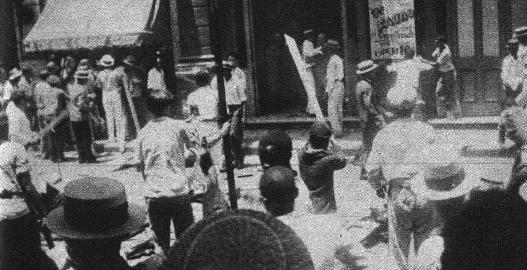
Earlier Uprising
In 1933 Batista was a sergeant in the Cuban Army employed as
court
shorthand writer. He decided politicos and Army
chieftains who
had just ousted "butcher-dictator" Machado were incapable of
governing. Batista's men took control after bloody
fighting.
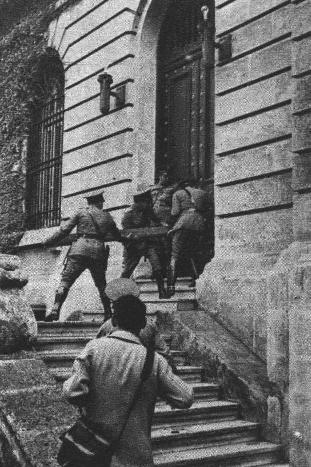
Police Storm Building 1933
while
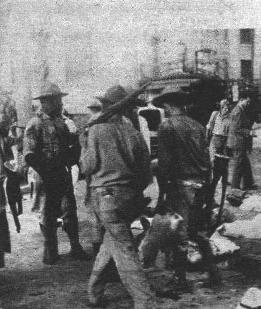
Army Tries to Quell
Disturbances
Once, Batista stepped from power long enough to permit
democratic
elections. He was defeated, exiled himself to the
United
States. On his return, he seized power, promising
democratic
elections and a square break for the poor. But Batista
is not
prone to risk power at a general election unless he is sure
of
winning. That he is not sure of his popularity with
the Cubans is
proved by the fact he has kept postponing the elections, for
one reason
or another. Many impartial observers are certain that
if
Batista's future were left up to the popular will, he would
no longer
occupy the presidency.
So in Cuba, like other Latin American countries, the
struggle is
between the dictators and the Communists. U.S.
interest in having
a stable democratic government in Cuba is imperiled.
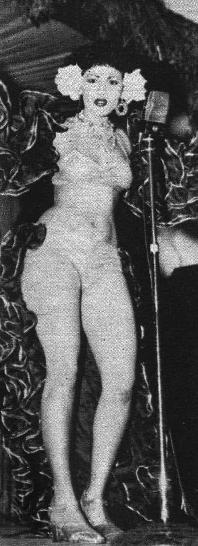
[To see a full size photo, right click and VIEW IMAGE]
Havana Continues as a
Tourist Attraction Despite the Violence ...
End of Page
Copyright
1998-2014 Cuban Information Archives. All Rights
Reserved.


